Examples
Copy these into the Before (pre-request) or After (post-request) section of a request’s Actions tab, with Python selected. Examples marked mock server work as they are against the free Chapar mock server with an environment that has baseUrl set to https://mocks.chapar.rest/api/v1.
Authentication
Save the token from a login response
After, on your login request:
@chapar.test("login succeeded")
def _():
    assert response.status_code == 200, response.text

data = response.json()
chapar.env.set("token", data["access_token"])
chapar.env.set("refreshToken", data.get("refresh_token", ""))
chapar.log("logged in, token expires in", data.get("expires_in"), "seconds")
Other requests then use Auth › Bearer with the token {{token}}, or set it on the collection once and Inherit it.
Log in automatically when the token is missing or expired
Before, on any request that needs a token. The script fetches a token with the requests package and remembers when it expires:
import time
import requests

if time.time() > float(chapar.env.get("tokenExpiresAt", "0")):
    r = requests.post(
        chapar.env.get("authUrl"),
        data={
            "grant_type": "client_credentials",
            "client_id": chapar.env.get("clientId"),
            "client_secret": chapar.env.get("clientSecret"),
        },
        timeout=5,
    )
    r.raise_for_status()
    token = r.json()
    chapar.env.set("token", token["access_token"])
    chapar.env.set("tokenExpiresAt", time.time() + token["expires_in"] - 30)
    chapar.log("fetched a new token")

request.headers["Authorization"] = "Bearer " + chapar.env.get("token")localhost in a script means the container, not your machine. To reach a server on your machine, use host.docker.internal (Docker Desktop and OrbStack).Skip the request until you are logged in
Before:
if not chapar.env.get("token"):
    chapar.skip("no token yet: send the Login request first")
Forget a token the server rejects
After:
if response.status_code == 401:
    chapar.env.unset("token")
    chapar.log("token rejected; it will be fetched again on the next send")
Changing the request
Sign the body with HMAC (mock server)
Before, on a POST {{baseUrl}}/echo with a JSON body. request.resolved.body is the body with {{variables}} filled in, exactly as it will be sent:
import hashlib, hmac, time

key = chapar.env.get("apiToken", "").encode()
if not key:
    chapar.skip("set apiToken in the environment first")

body = request.resolved.body.encode()
request.headers["X-Timestamp"] = str(int(time.time()))
request.headers["X-Signature"] = hmac.new(key, body, hashlib.sha256).hexdigest()After, check that the server received it (the mock server’s /echo returns the headers it got):
echo = response.json()

@chapar.test("server received the signature")
def _():
    assert "X-Signature" in echo["headers"]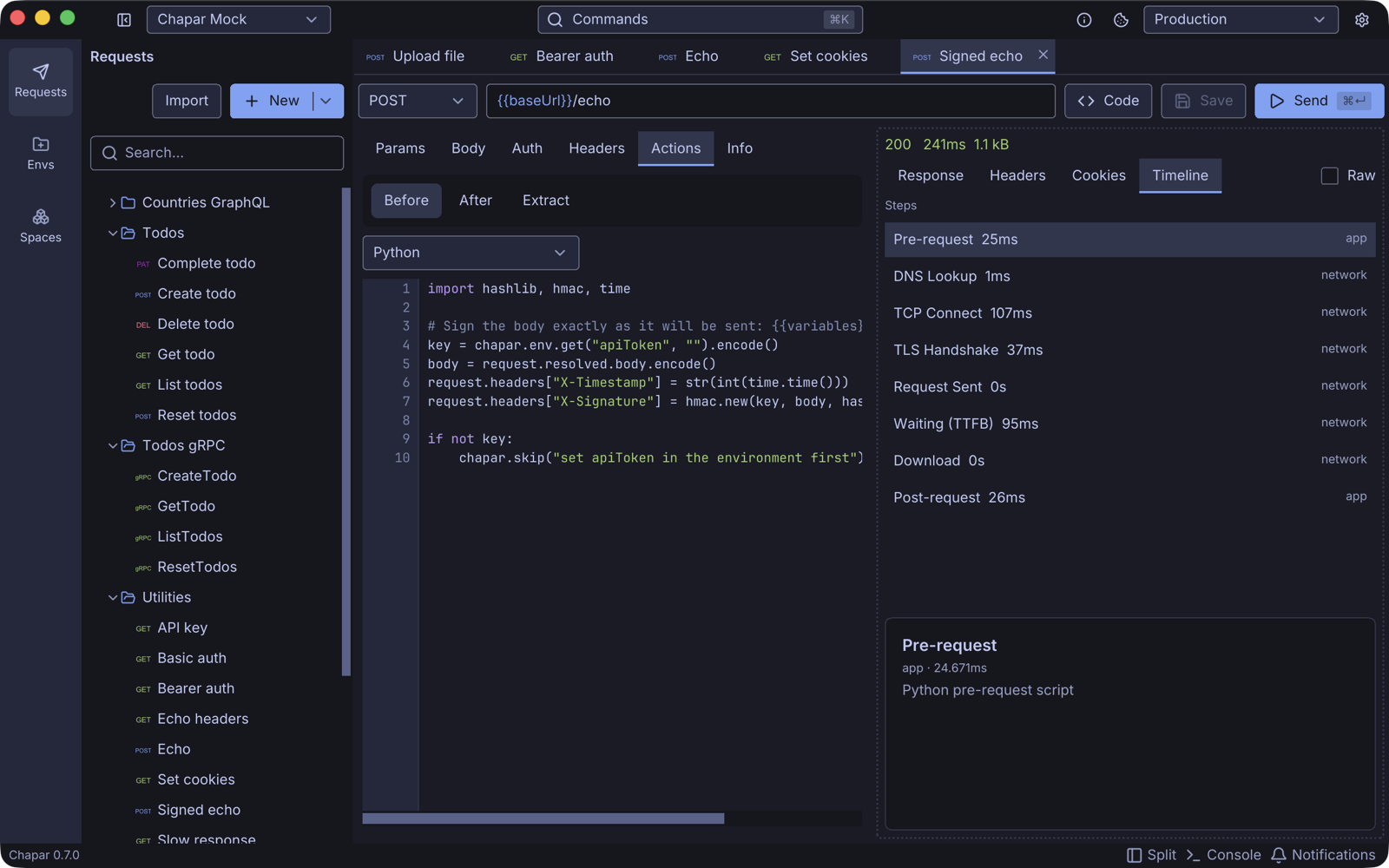
Add a request id and an idempotency key
Before:
import uuid

request.headers["X-Request-Id"] = str(uuid.uuid4())
if request.method in ("POST", "PUT", "PATCH"):
    if not request.headers.get("Idempotency-Key"):
        request.headers["Idempotency-Key"] = str(uuid.uuid4())
Edit the JSON body (mock server)
Before, on POST {{baseUrl}}/todos:
todo = request.json()
todo["title"] = todo["title"].strip()
todo.setdefault("tags", []).append("from-chapar")
todo["due_at"] = "{{timeNow}}"          # filled in after the script
request.set_json(todo)
Switch the target by environment
Before:
if chapar.env.name == "Production" and request.method != "GET":
    chapar.skip("write requests are blocked in Production")

request.query["debug"] = "1" if chapar.env.name == "Local" else "0"
Testing responses
Status, time, headers and body (mock server)
After, on GET {{baseUrl}}/todos:
todos = response.json()["data"]

@chapar.test("status is 200")
def _():
    assert response.status_code == 200, response.status

@chapar.test("responds in under a second")
def _():
    assert response.elapsed_ms < 1000, f"took {response.elapsed_ms:.0f} ms"

@chapar.test("returns JSON")
def _():
    assert response.headers.get("Content-Type", "").startswith("application/json")

@chapar.test("every todo has an id and a title")
def _():
    for t in todos:
        assert t.get("id") and t.get("title"), t

@chapar.test("priorities are valid")
def _():
    assert {t["priority"] for t in todos} <= {"low", "medium", "high"}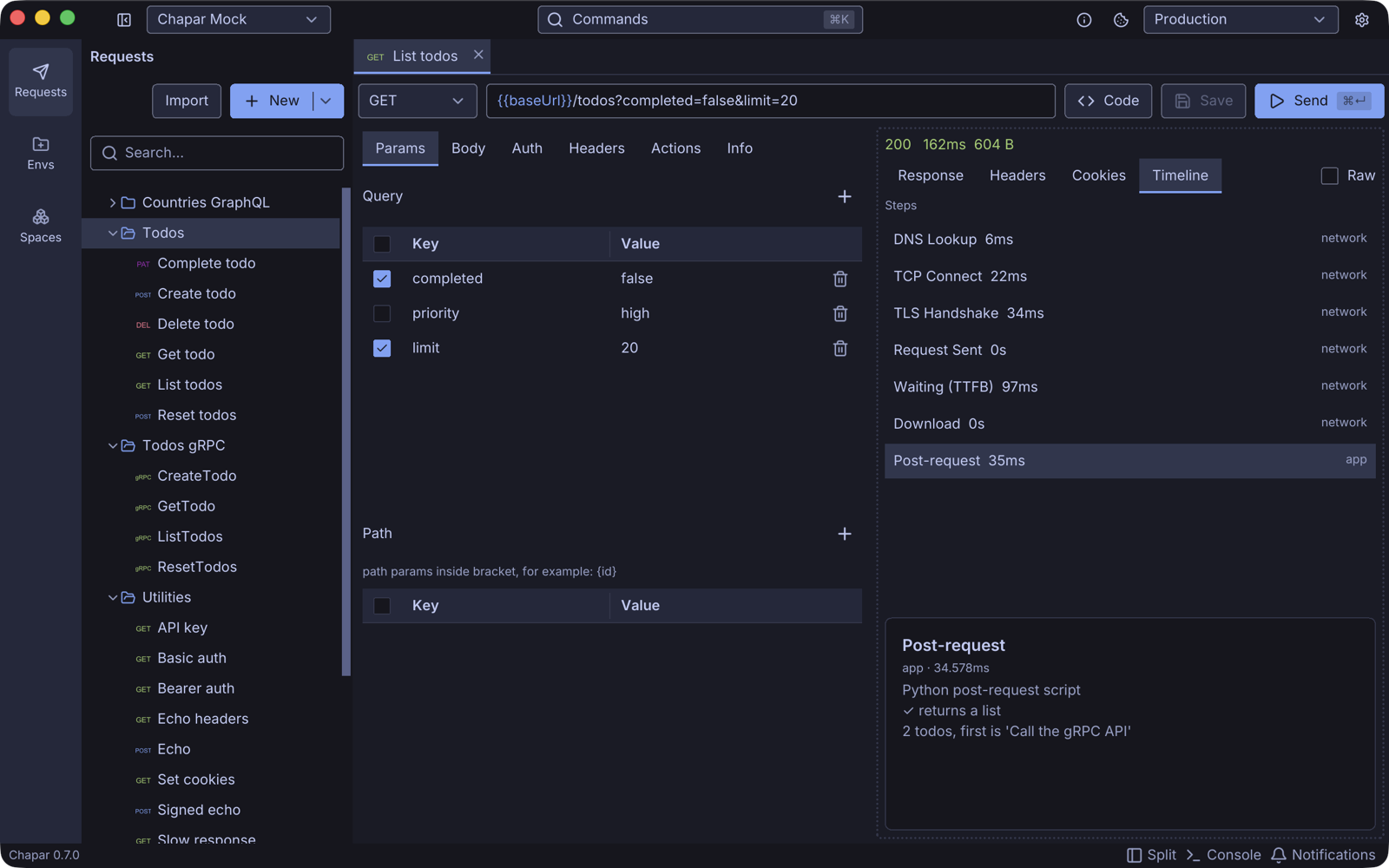
Keep values for the next request (mock server)
After, on POST {{baseUrl}}/todos:
if response.status_code == 201:
    todo = response.json()["data"]
    chapar.env.set("todoId", todo["id"])
    chapar.env.set("todoTags", todo["tags"])     # a list: stored as JSON text
Then use {{baseUrl}}/todos/{{todoId}} in the next request. In another script, read the list back with json.loads(chapar.env.get("todoTags")).
Walk through pages
After, on a paged list request whose URL ends in ?offset={{offset}}&limit=20:
page = response.json()
offset = page["offset"] + page["limit"]
if offset < page["total"]:
    chapar.env.set("offset", offset)
    chapar.log("next page starts at", offset)
else:
    chapar.env.set("offset", 0)
    chapar.log("that was the last page")
Read a cookie (mock server)
After, on GET {{baseUrl}}/cookies/set?session=abc:
session = response.cookie("session")
chapar.test("server set a session cookie", lambda: session == "abc")
chapar.env.set("sessionCookie", session)
gRPC
For gRPC, request.url is the server address, request.method the full method name, request.metadata the metadata, and request.body the JSON message. response.status_code is the gRPC status code, where 0 is OK.
Add metadata and fill the message (mock server)
Before, on mock.v1.TodoService/CreateTodo:
import uuid

request.metadata["x-session-id"] = chapar.env.get("sessionId", "public")
request.metadata["x-request-id"] = str(uuid.uuid4())

msg = request.json()
msg.setdefault("priority", "TODO_PRIORITY_MEDIUM")
request.set_json(msg)
Check the status, trailers and message (mock server)
After, on mock.v1.TodoService/ListTodos:
todos = response.json().get("todos", [])

@chapar.test("gRPC status is OK")
def _():
    assert response.status_code == 0, f"{response.status}: {response.error}"

chapar.log(len(todos), "todos, trailers:", response.trailers.to_dict())
if todos:
    chapar.env.set("todoId", todos[0]["id"])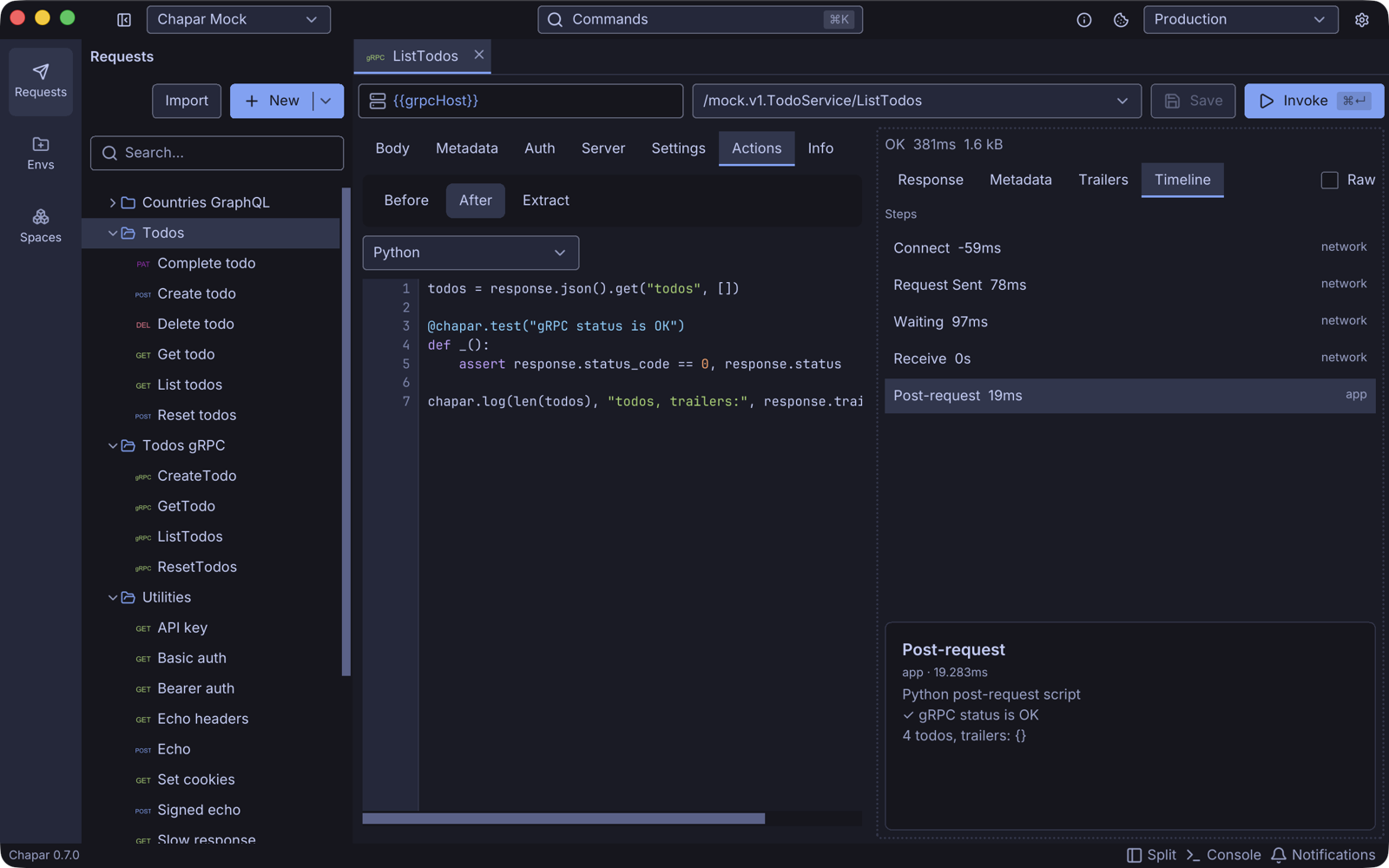
Expect an error status (mock server)
After, on mock.v1.UtilityService/Status with the message {"code": 5, "message": "gone"}:
@chapar.test("returns NOT_FOUND")
def _():
    assert response.status_code == 5
    assert not response.ok
GraphQL
For GraphQL, the document and variables are in request.graphql, and a response’s data and errors are parsed for you.
Set query variables
Before:
variables = request.graphql.variables or {}
variables["code"] = chapar.env.get("countryCode", "IR")
request.graphql.variables = variables
Check for errors and keep data
After, on a country(code: $code) query against https://countries.trevorblades.com/graphql:
@chapar.test("no GraphQL errors")
def _():
    assert not response.errors, response.errors

country = response.data["country"]
chapar.env.set("capital", country["capital"])
chapar.log(country["name"], "-", country["capital"])
Debugging scripts
- Use
print(...)orchapar.log(...)freely; the output is in the Timeline, under the Pre-request or Post-request step. print(request.resolved.url)andprint(request.resolved.headers.to_dict())show what will really be sent.- An exception names its line:
line 4: KeyError: 'data'. Useresponse.json().get("data")when a field is optional. - The Console in the footer has Chapar’s own logs, including executor errors.